

A Red Tibetan Mastiff called Big Splash has become the world's most expensive dog
His owner will need a big house too, as adult Tibetan Mastiffs have been known to weigh as much as 286lb, or more than 20 stone – the same as a sizeable rugby player. However the typical weight for a fully grown Tibetan Mastiff is around 13 stone.
WHY THIS MOST EXPENSIVE DOGS:
But
according to one breeder Lu Lian, He said: Big Splash is a 'perfect specimen' and
the extravagant price for the 11-month-old is completely justified.
He
said: 'We have spent a lot of money raising this dog, and we have the
salaries of plenty of staff to pay' – adding that the new owner could
charge almost £10,000 a time for Big Splash to breed with a female.
The high price paid for the dog is a
sign that the red Tibetan mastiff has become a status symbol in China,
replacing jewellery and cars as a way for the super-rich to show off
their wealth.
Not only is red considered a lucky colour, but Tibetan mastiffs are thought to be holy animals, blessing their owners' health and security.
Not only is red considered a lucky colour, but Tibetan mastiffs are thought to be holy animals, blessing their owners' health and security.
Tibetans
believe the dogs have the souls of monks and nuns who were not good
enough to be reincarnated as humans or into Shambhala, the heavenly
realm.
Don't you just want to hug one? You can - for $2 million.
A Tibetan mastiff puppy in China fetched a record-breaking price in what may be the world's most expensive dog sale, according to local media reports.
The giant, furry canines were once used for hunting in Central Asia and Tibet, and are said to have "lion's blood." They weigh upwards of 100 pounds and are known for their loyalty and guardian instincts.
The 12 million yuan ($1.9 million) dog, a golden-haired puppy measuring 31 inches tall and weighing nearly 200 pounds, was purchased by a 56-year-old property developer from Qingdao, according to the report in the Qianjiang Evening News.
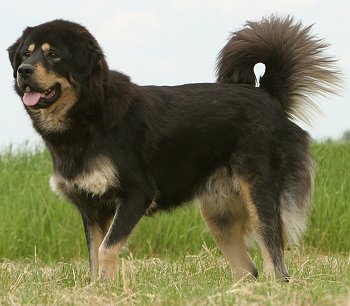
From Wikipedia: HISTORY. “Pure Tibetan mastiffs are very rare, just like our nationally treasured pandas, so the prices are so high," said the dog's breeder Zhang Gengyun, according to AFP.
One red mastiff named "Big Splash" reportedly sold for 10 million yuan ($1.5 million) in 2011, the most expensive dog sale then recorded.
This is an ancient breed. It has been theorized that an early Tibetan dog is the ancestor to all Colossus breeds, although this is disputed by most experts. A highly questionable study at Nanjing Agricultural University's Laboratory of Animal Reproductive Genetics and Molecular Evolution in Nanjing, China, found that while most common dog breeds genetically diverged from the wolf approximately 42,000 years ago, the Tibetan Mastiff genetically diverged from the wolf approximately 58,000 years ago.
In the early 19th century, King George IV owned a pair of Tibetan Mastiffs, and enough of the breed were available in England in 1906 to be shown at the Crystal Palace show. However, during the war years, the breed lost favor and focus and nearly died out in England.
After 1980, the breed began to gain in popularity worldwide. Although the breed is still considered somewhat uncommon, as more active breeders arose and produced adequate numbers of dogs, various registries and show organizations (FCI, AKC) began to recognize the breed.
In other words, this self-reliant dogs will attempt to take control of every situation unless you are an assertive leader who demands respect.
The Tibetan Mastiff is serious and dignified, calm and quiet -- unless provoked. Aloof with strangers, he will remain watchful every moment they are on his property. This breed is typically patient with his own children and other family pets, but requires careful introduction to those outside the family.
The Tibetan Mastiff often prefers to be outdoors where he can view and patrol his territory... However, despite his bulk, this breed is remarkably agile, skilled at climbing and jumping, and requires a six-foot-high fence. Tibetan Mastiffs also have a deep, impressive bark which they tend to use freely, especially at night when they are most attentive. And they sometimes dig deep holes to lie in.
All in all, most Tibetan Mastiffs are "too much dog" for the average household. Very few people really have the facilities or skills necessary to manage this breed and keep him happy.
Since AKC recognition, the number of active breeders has skyrocketed, leading to over-production of puppies, many of which are highly inbred and of questionable quality. Initially, the breed suffered because of the limited gene pool from the original stock, but today's reputable breeders work hard at reducing the genetic problems through selective breeding and the international exchange of new bloodlines. However, some few breeders cling to the practice of inbreeding, do not perform health tests on their breeding stock, and do not support buyers of the puppies they produce. Many puppies and adult dogs end up in shelters and in rescue situations.
In 2008, the Tibetan Mastiff competed for the first time in the Westminster Kennel Club Dog Show.
A Chinese woman was reported to have spent more than 4 million yuan to buy an 18-month-old purebred male Tibetan Mastiff, which she named Yangtze In March 2011, a red Tibetan mastiff was reported to have been sold to a 'coal baron' from northern China for 10 million yuan. There have been other similar reports of dogs sold for astronomical prices; however, most of these appear to be breeders' attempts to drive up the prices of their dogs. Photos of dogs shown on web sites are frequently photo shopped to exaggerate color intensity, size, and "bone". By 2015, due to copious production by breeders and unsuitability of the breed as a pet in urban situations, prices in China for the best dogs had fallen to about $2,000 and lower quality and cross-breed dogs were being abandoned

No comments:
Post a Comment